

Blockchain has had a long and bumpy road. For years, it was surrounded by bold promises, speculative investment, and more than a few spectacular failures. However, the story in 2026 is fundamentally different. The technology has quietly moved out of the boardroom whiteboard and into the operational core of global finance, logistics, and medicine. Today, 90% of global enterprises are actively implementing blockchain, and a significant share of cross-border business-to-business (B2B) payments now moves on blockchain rails.
So what changed? In short, organizations stopped trying to replace everything with blockchain and started using it to fix specific, costly problems. That shift in mindset is why the technology finally works.
This post walks through what enterprise blockchain actually looks like in 2026 — across payments, supply chains, and healthcare — and explains the regulations and real-world lessons that got us here.
1. The Global Payments Revolution: Stablecoins Take Over B2B Settlement
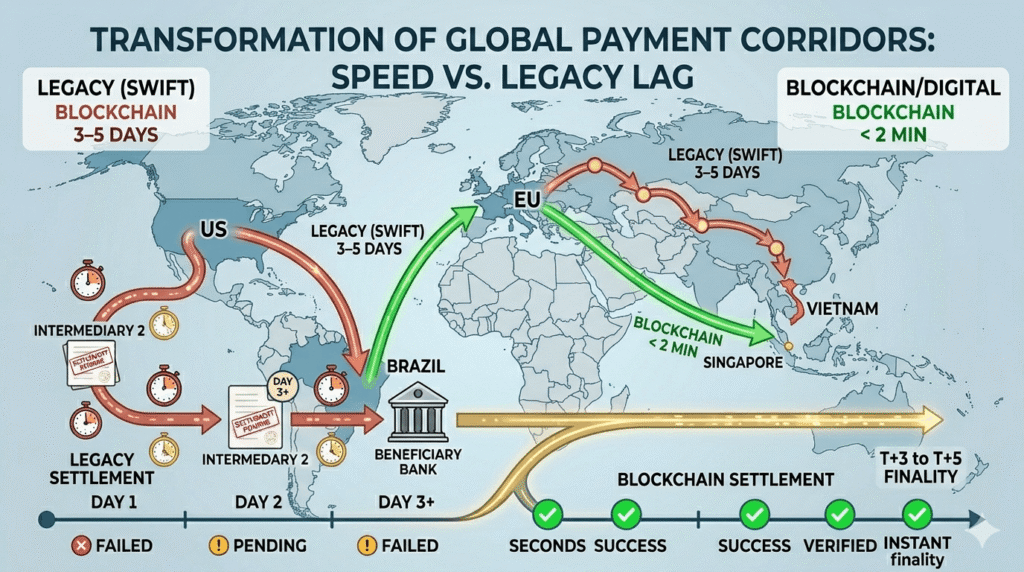
Cross-border business payments have historically been slow, expensive, and opaque. The traditional SWIFT correspondent banking model required payments to hop through multiple intermediary banks — each one adding time, cost, and friction. Settlement times of three to five business days were standard, and total fees (including foreign exchange spreads) regularly reached between 3% and 7% of the transaction value (Due, 2026).
In a world where digital commerce runs 24/7, that kind of delay is no longer acceptable. Consequently, stablecoins and blockchain-based settlement have stepped in to fill the gap.
How Stablecoins Became the New B2B Rail
In 2025, stablecoins processed over $33 trillion in total transfer volume. When automated trading and wash activity are stripped out, genuine economic transactions accounted for approximately $9 trillion. To put that in perspective, that is more than half of Visa’s annual throughput and five times the volume handled by PayPal.
The reason enterprises prefer stablecoins like USDC and PYUSD is simple: they are fast, cheap, and — crucially — regulated. Unlike the early days of unbacked algorithmic tokens, the regulated stablecoins of 2026 are required to maintain 100% backing in high-quality liquid assets such as U.S. Treasuries and cash held at regulated custodians. That gives corporate treasurers the confidence to use them for high-value B2B settlements, where the average transaction size is $35,000.
The Cost and Speed Advantage in Practice
The practical benefits show up clearly in a few areas:
- Lower fees: Eliminating correspondent banks brings the total cost of an international transfer below 1%, compared to 3–7% via traditional banking (Due, 2026).
- Near-instant settlement: Regulated stablecoins settle in seconds to minutes, available 24/7. Legacy SWIFT can take 1–5 business days and only operates during business hours.
- Maximum transparency: Every transaction is recorded on-chain, giving finance teams a real-time, auditable view of cash flows.
- Programmable money: Smart contracts allow payments to trigger automatically when conditions are met — for example, when goods arrive at a port or an invoice is verified.
SWIFT Fights Back: The Blockchain Shared Ledger
By 2026, the system has enabled 75% of payments on the network to reach beneficiary banks within 10 minutes. That is a major improvement, though ‘last-mile’ friction within local banking systems remains a challenge that blockchain settlement continues to address.
Emerging Markets and the Multi-Chain Reality
For example, SpaceX’s Starlink and Scale AI have used stablecoins to pay contractors and collect payments in regions with fragmented financial systems.
To support this reach, enterprises are deploying multi-chain infrastructure. Stablecoin supply now sits across Ethereum, Solana, Tron, and various Layer 2 rollups. Each network offers different trade-offs: Ethereum delivers maximum security and institutional liquidity, while Solana and Tron offer sub-second finality and near-zero fees for high-volume payouts.
2. The Regulatory Foundations: MiCA and the GENIUS Act
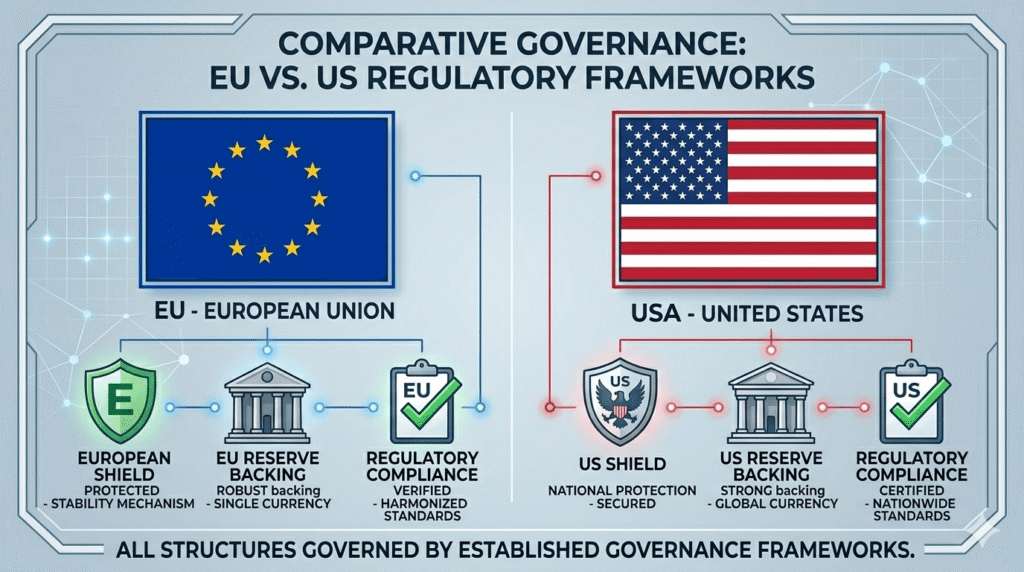
The transition of stablecoins from a niche cryptocurrency curiosity into core B2B infrastructure was only possible because governments finally created clear rules. In 2025 and 2026, policymakers moved from debating the legitimacy of digital assets to defining specific, enforceable standards for their use.
The EU: MiCA Sets the Global Standard
The Markets in Crypto-Assets (MiCA) framework, fully active as of late 2024, established the world’s first unified rulebook for digital assets across 27 EU member states. By 2026, its impact on the European stablecoin market is unmistakable.
MiCA classifies tokens into two types: Electronic Money Tokens (EMTs), which are pegged to a single fiat currency, and Asset-Referenced Tokens (ARTs), which are linked to a basket of assets. For enterprises operating in Europe, the rules are clear:
- Issuers must maintain a registered office within the EU
- At least 30% of reserve funds must be held in separate accounts at credit institutions
- Redemption at par must be guaranteed at all times
The result has been a ‘binary’ market. EU-regulated Crypto-Asset Service Providers (CASPs) have offboarded non-compliant tokens, standardising the region around high-transparency assets like EURC and MiCA-compliant USDC.
The US: The GENIUS Act Ends a Decade of Uncertainty
In the United States, the passage of the Guiding and Establishing National Innovation for U.S. Stablecoins (GENIUS) Act in July 2025 marked a turning point. For the first time, there was a clear federal framework for ‘payment stablecoins’. Issuance is now restricted to regulated banks, credit unions, and specially licensed non-bank issuers, all under the supervision of the Office of the Comptroller of the Currency (OCC).
The GENIUS Act also requires reserves to be held in highly liquid, low-risk assets and subjected to regular third-party audits. Crucially, the Act explicitly enables traditional financial institutions to get involved, leading JPMorgan, Wells Fargo, and Citigroup to enter the stablecoin issuance and custody space (PYMNTS, 2025). This has effectively de-risked the asset class for corporate treasuries.
Global Alignment on Key Principles
Beyond the US and EU, other major economies have also moved to regulate stablecoins clearly. The table below shows how major jurisdictions align:
| Jurisdiction | Legislation | Oversight | Reserve Rules | Redemption |
| European Union | MiCA | EBA / ESMA | 100% Liquid; 30% Bank Deposits | Same-day or Next-day |
| United States | GENIUS Act | OCC / Fed Reserve | High-Quality Liquid Assets (HQLA) | Timely (at par) |
| Hong Kong | Stablecoin Ordinance | HKMA | Full Reserve; Locally Incorporated | At par; timely |
| United Kingdom | BoE Regime | Bank of England / FCA | Backing Asset Quality Focus | Guaranteed certainty |
| Japan | PSA Amendment | FSA | Licensed Trust/Bank Issuers | Strict par redemption |
Source: Skadden, 2026; BVNK, 2026
3. Supply Chain Transparency: Blockchain Becomes the Trust Layer
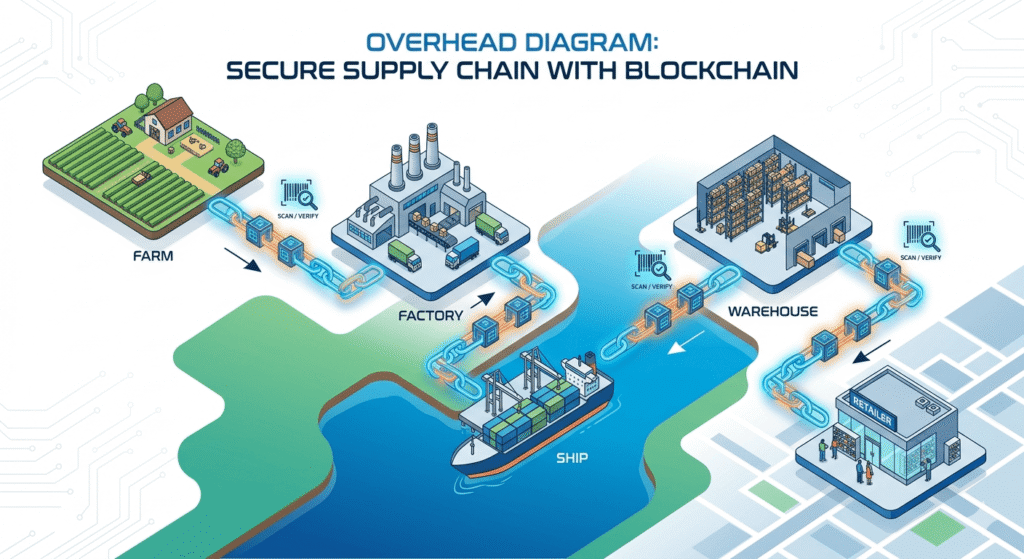
In supply chain management, blockchain has moved well beyond basic tracking. By 2026, it has become the standard architecture for creating what analysts call ‘digital trust layers’ — shared visibility platforms that connect every participant in a multi-party ecosystem, from raw material suppliers to end consumers.
Food Safety: IBM Food Trust and the Surgical Recall
The public health impact is significant. When a contamination event occurs, the ability to trace a product back to its farm of origin in seconds (rather than weeks) enables ‘surgical’ recalls. This prevents the massive economic waste associated with broad, precautionary recalls that pull safe products off shelves unnecessarily (Supply Chain Digital, 2026). As a result, the global food traceability market surpassed $41 billion in 2025, with North America leading adoption due to strict unit-level tracking mandates.
Automotive: EVs, Ethics, and the MOBI Standards
Luxury Goods: The Digital Product Passport
The luxury sector has adopted blockchain as its primary defence against counterfeiting. The Aura Blockchain Consortium, founded by LVMH, Prada, Cartier, and Mercedes-Benz, has registered over 70 million products by 2026. Each product receives a unique digital identity that tracks its lifecycle from raw material sourcing through to resale.
Case Study: Tom Tailor and Retraced — Onboarding Suppliers at Scale
One of the biggest practical barriers to supply chain blockchain has always been getting suppliers to join. The 2025 collaboration between fashion brand Tom Tailor and the platform Retraced cracked this problem.
Within just three months, the project onboarded 240 suppliers (80 Tier 1 and 160 Tier 2), achieving 100% participation. The key was giving suppliers a clear incentive: simplified compliance reporting for the German Due Diligence Act. By 2026, the system traces 17% of purchase orders down to the raw material level and 13% to the yarn level — an unprecedented level of visibility in the fashion industry.
4. Healthcare and Pharma: Blockchain Solves the Data Trust Problem
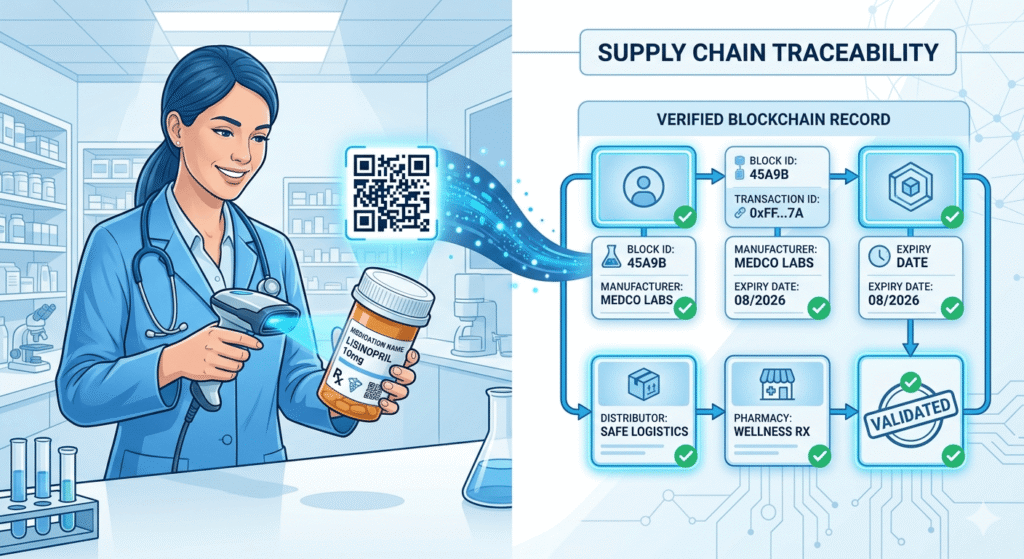
Healthcare has emerged as one of the largest blockchain markets, with the supply chain management segment alone representing the biggest share of the $11.7 billion market in 2025 (Polaris Market Research, 2026). Adoption is driven by three converging needs: regulatory compliance, data accuracy, and interoperability.
Pharmaceutical Traceability: MediLedger and DSCSA Compliance
The US Drug Supply Chain Security Act (DSCSA) requires all pharmaceutical trading partners — manufacturers, wholesalers, and dispensers — to implement unit-level electronic track-and-trace by late 2025. The MediLedger Network, managed by Chronicled, has become the leading solution: a permissioned blockchain that enables interoperability without requiring a single central database.
The compliance rollout has proceeded by tier:
- Manufacturers: Fully compliant since May 2025 (unit-level serialisation and data upload)
- Wholesale Distributors: Fully compliant since August 2025 (verification of saleable returns)
- Large Dispensers: Fully compliant since November 2025 (electronic data storage for 6 years)
- Small Pharmacies: Deadline: November 2026 (integration with 3PL/wholesaler portals)
A critical innovation powering MediLedger is the use of Zero-Knowledge Proofs (ZKPs). This cryptographic technique allows a manufacturer to prove that a product is authentic and has a valid serial number without revealing production volumes or specific trading partner identities to other network participants. This privacy-preserving feature was essential for getting competing pharmaceutical giants to participate on the same platform.
Provider Data: The Synaptic Health Alliance
In the administrative layer of healthcare, the Synaptic Health Alliance — comprising Humana, UnitedHealth Group, Quest Diagnostics, and MultiPlan — uses blockchain to tackle a surprisingly costly problem: inaccurate provider directories.
Before the alliance, errors in provider data (wrong locations, incorrect specialties) affected 52% of listings, leading to billing disputes and patient frustration (Synaptic Health Alliance, 2026). By sharing the Provider Data Exchange (PDX) on a permissioned ledger, members now collaboratively update and audit provider information. This eliminates duplicate outreach, reduces administrative burden, and creates a single source of truth across the network. Plans are already underway to expand into claims processing and clinical study data sharing (Synaptic Health Alliance, 2026).
Real-World Evidence: The MELLODDY Consortium
The result has been dramatically improved AI model performance for drug discovery — while ensuring full compliance with GDPR and other data privacy regulations. This model shows where the intersection of blockchain and AI is heading: trustworthy, auditable, privacy-preserving intelligence.
5. Why Past Blockchain Projects Failed (And What 2026 Winners Did Differently)

The maturity of 2026’s blockchain ecosystem was hard-won. High-profile failures between 2022 and 2024 — including TradeLens, B3i, and we.trade — taught the industry valuable lessons about what actually makes blockchain deployments work (Frontiers, 2025).
The Governance Trap: TradeLens and we.trade
TradeLens, the joint venture between Maersk and IBM, is the textbook case in governance imbalance. Despite impressive technology, the platform could not attract Maersk’s competitors, who saw it as a centralised model dominated by a single shipping line. Without neutrality, there was no truly open ecosystem: terminal operators and carriers were unwilling to share data on a platform they did not help govern.
Similarly, WeTrade owned by 12 major European banks collapsed in 2022 when it ran out of investment. Although the underlying Hyperledger Fabric technology worked correctly, only two of the founding banks ever fully deployed the system for clients. High operational costs, a complex consortium management structure, and weak demand from the banks’ own corporate customers combined to make the business model unsustainable.
The Integration Problem: B3i and Legacy IT
B3i, the insurance industry’s blockchain initiative, failed to move most reinsurer members beyond the pilot stage. The core problem was not the technology — it was that blockchain is not a plug-and-play replacement for legacy IT. Achieving end-to-end efficiency required insurers, brokers, and reinsurers to adopt smart contracts simultaneously, and that level of industry-wide coordination proved impossible to achieve in the short term.
What the Successful 2026 Projects Did Right
| The winners of 2026 solved real, specific problems. They did not deploy blockchain for its own sake. |
- Neutrality and equal governance: Successful consortia like Aura and Synaptic adopted non-profit or equal-vote structures so no single entity dominated.
- Specific pain points over hype: Projects that targeted compliance (MediLedger/DSCSA) or data accuracy (Synaptic) succeeded because they addressed immediate, costly problems — not hypothetical future benefits.
- Incentive alignment: Tom Tailor’s success shows the importance of giving suppliers concrete incentives to participate, such as reducing their compliance reporting burden.
- Integration, not replacement: Successful 2026 implementations treat blockchain as an add-on that increases the value of existing ERP systems, not a total replacement.
6. The Technology Under the Hood: What Makes It Work in 2026
Layer 2 Rollups: Solving the Scalability Problem
The scalability issues that plagued early blockchain networks have been largely resolved through Layer 2 scaling solutions and improved consensus mechanisms. In 2026, enterprises are increasingly using ‘Rollup Services’ to launch customised Layer 2 blockchains. These rollups inherit the security of established networks like Ethereum while offering the high throughput and low fees required for high-frequency B2B settlement (Alchemy, 2026). Providers like Alchemy, Conduit, and Caldera allow organisations to deploy dedicated execution environments with minimal operational overhead.
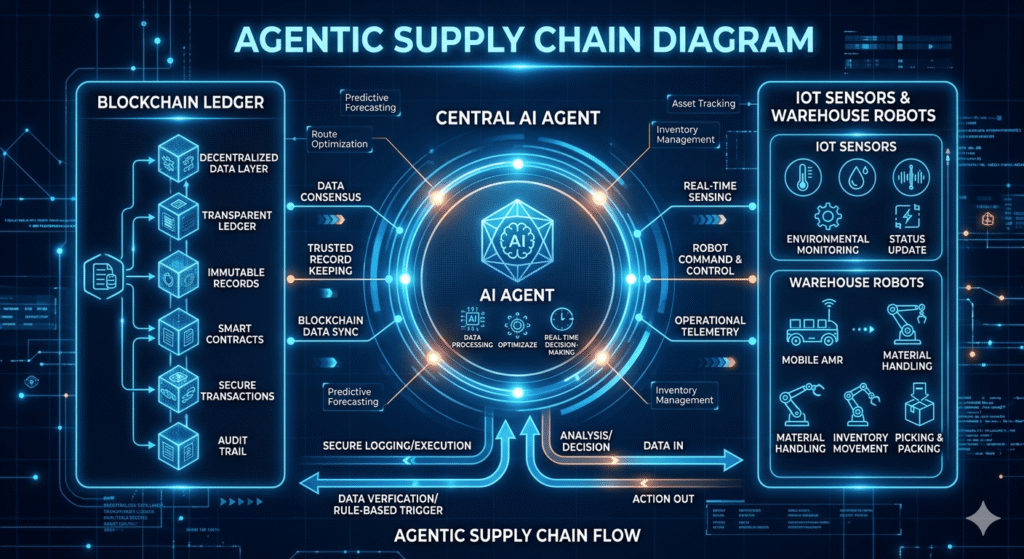
Blockchain Meets AI: The Agentic Supply Chain
Blockchain-as-a-Service: Lowering the Entry Barrier
Cloud providers including AWS, Microsoft Azure, and Oracle now offer Blockchain-as-a-Service (BaaS) platforms. These have become the default starting point for 83% of organisations, enabling them to deploy blockchain networks without building infrastructure from scratch. Crucially, this has lowered the barrier to entry for SMEs, who can now participate in global supply chain or payment networks with minimal technical expertise.
Era of Utility Has Arrived
As of 2026, blockchain technology has navigated past the ‘trough of disillusionment’ and arrived at genuine, production-grade utility. Stablecoins have established themselves as a viable, regulated alternative to traditional banking rails especially for cross-border B2B settlement. In supply chain and healthcare, blockchain has become the standard for transparency and traceability at a level that was previously impossible.
The next phase of development will be characterised by ‘invisibilisation.’ As interoperability standards mature and user interfaces simplify, the blockchain infrastructure will become as unremarkable as the TCP/IP protocol that powers the internet. The competitive advantage will no longer come from simply using blockchain. It will come from how effectively an organisation leverages the real-time, trusted data that blockchain provides.
| The successful organisations of 2026 have moved past the technical features of blockchain to focus on business value. By solving for trust in multi-party environments, they have unlocked new revenue opportunities in programmable finance, ethical sourcing, and personalised healthcare (Boosty Labs, 2025). |
The era of speculation is over. The era of utility has arrived.