Every year, Nigerian financial institutions absorb fraud losses that their compliance systems did not catch in time. The fraudsters moved fast. The systems moved slowly. The money was gone before the alert fired.
This is not a technology problem. It is a strategy problem, and it belongs in the boardroom, not just the compliance department.
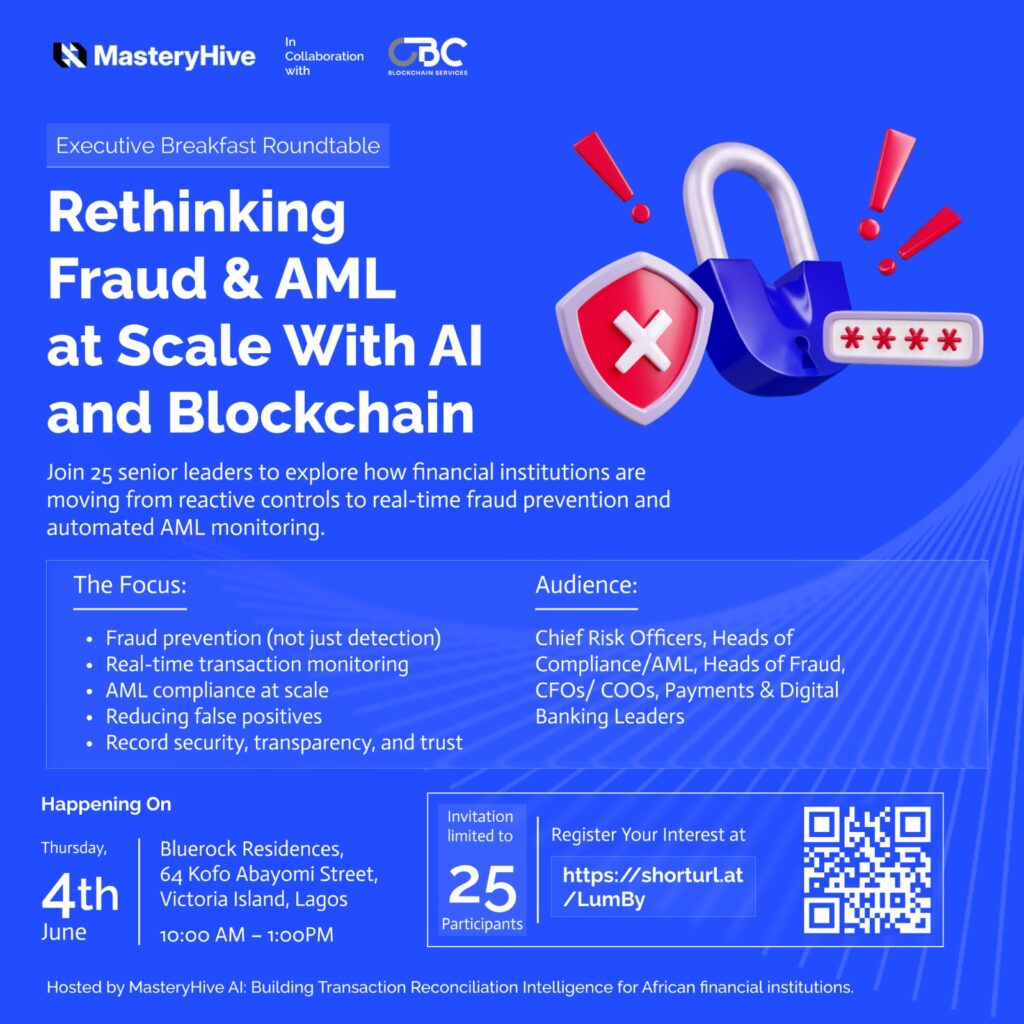
On Thursday, 4th June 2026, MasteryHive AI and CBC Blockchain Services will host a closed Executive Breakfast Roundtable for 25 senior financial leaders at Bluerock Residences, Victoria Island, Lagos. The topic is one every institution in Nigeria needs to confront directly: “Rethinking Fraud & AML at Scale With AI and Blockchain.”
Twenty-five seats. No exceptions. No overflow list.
The Problem With How Financial Institutions Currently Fight Fraud
Most financial institutions in Nigeria still operate fraud and AML programmes built around a core assumption that no longer holds: that you can detect and respond to fraud after it happens and still limit the damage.
That assumption was questionable a decade ago. Today it is indefensible.
Transaction volumes have multiplied. Digital channels have created attack surfaces that rule-based detection systems were never designed to cover. Fraudsters have professionalised. Synthetic identity fraud, account takeover schemes, and layered money laundering structures now move faster and operate at a scale that overwhelms manual review teams.
The institutions that still rely on static rule sets are fighting a dynamic, adaptive threat with tools that cannot learn. Their compliance teams spend the majority of their time chasing false positive transactions the system flagged incorrectly while real threats move through the gaps.
The cost is not just financial. Regulatory scrutiny on AML compliance is intensifying across Sub-Saharan Africa. Correspondent banking relationships depend on demonstrable compliance quality. Reputational damage from a publicised fraud failure compounds the direct loss many times over.
Something has to change. This roundtable is the room where that conversation happens at the level it needs to.
What This Roundtable Addresses
The session focuses on five areas where AI and blockchain directly improve fraud prevention and AML outcomes:
Fraud Prevention, Not Just Detection
The shift from reactive detection to proactive prevention is the central theme of this roundtable. AI models trained on transaction behaviour can identify anomalous patterns before a fraudulent transaction clears, not after. The discussion examines how leading institutions have made that shift and what the implementation pathway looks like for Nigerian banks and payment providers.
Real-Time Transaction Monitoring
Batch monitoring catches fraud that has already moved. Real-time monitoring stops it in transit. The roundtable covers the architecture decisions, data requirements, and operational changes that make real-time monitoring viable at scale, not just in a proof-of-concept environment but also in a live, high-volume transaction processing context.
AML Compliance at Scale
As transaction volumes grow, manual AML processes do not scale. They break. AI-powered compliance systems grow with the business, applying consistent standards across every transaction regardless of volume. The session examines how to build AML infrastructure that satisfies regulators today and handles the next five years of growth without requiring a proportional increase in compliance headcount.
Reducing False Positives
An AML system that generates too many false positives is nearly as costly as one that misses real threats. Compliance teams buried in false alerts become desensitised, response times slow, and genuine risks slip through the noise. AI-driven calibration reduces false positive rates dramatically freeing compliance professionals to focus on real risk rather than noise management.
Record Security, Transparency, and Trust
Blockchain creates transaction records that nobody can alter, delete, or dispute. For financial institutions operating under regulatory scrutiny, that auditability is both a compliance asset and a reputational one. The roundtable examines how blockchain-based record infrastructure integrates with existing core banking systems and what the regulatory posture toward these solutions looks like in the Nigerian context.
Why 25 Seats
Most industry events optimise for size. This one optimises for quality.
A roundtable of 25 senior executives enables a conversation that a conference of 200 cannot. Every participant at the table carries institutional authority. Every question raised is a real strategic question from someone with accountability for the answer. The facilitated discussion produces outputs shared frameworks, tested ideas, peer perspectives that would dissolve in a larger room.
MasteryHive AI and CBC Blockchain Services have designed the format around this principle: the most valuable thing an executive can take from a session like this is not a presentation deck. It is a clearer strategic direction, validated against the thinking of peers who are navigating the same challenges at the same level.
Twenty-five seats is not a marketing constraint. It is a design decision.
Who Belongs in the Room
This roundtable targets the executives closest to fraud and compliance risk:
- Chief Risk Officers setting enterprise-wide risk strategy
- Heads of Compliance and AML responsible for regulatory adherence and programme design
- Heads of Fraud managing detection, prevention, and investigation functions
- CFOs and COOs balancing compliance investment against operational performance
- Payments and Digital Banking Leaders overseeing the channels where fraud risk is highest
If your role puts you at the intersection of financial risk, compliance obligation, and strategic technology decisions, this is your room.
The Convening Partners
MasteryHive AI builds Transaction Reconciliation Intelligence for African financial institutions. Its focus on real-time financial data processing gives it a practitioner’s understanding of where fraud prevention and AML monitoring systems succeed and fail in African market conditions.
CBC Blockchain Services specialises in compliant blockchain solutions for regulated financial markets. Its work directly addresses the record integrity and audit trail requirements that sit at the heart of robust AML compliance bringing both the technical depth and regulatory awareness the topic demands.
Secure Your Place
Date: Thursday, 4th June 2026
Time: 10:00 AM – 1:00 PM
Venue: Bluerock Residences, 64 Kofo Abayomi Street, Victoria Island, Lagos
Invitation strictly limited to 25 participants
Register your interest: https://shorturl.at/LumBy
Fraud and AML compliance are not back-office problems. They are strategic risks that boards, regulators, and correspondent banking partners scrutinise with increasing intensity. The institutions that treat them as such and invest in the tools and leadership conversations to match are the ones that build the trust that defines competitive advantage in Nigerian financial services.
June 4th is a three-hour investment in getting that strategy right. Register before the seats are gone.