By the CBC Blockchain Services Research Desk | Category: Research | Stablecoins
Stablecoin market cap slipped 3.48% in October to $284.86 billion, yet monthly transfer volume jumped almost 40% to $9.86 trillion. The month’s biggest stories were regulatory and security-related. U.S. regulators finalised a key GENIUS Act rule, European regulators put USDC under direct supervision, and Tether and Circle froze billions of dollars in stablecoins after the 29 October Binance hack. Here is the full October 2026 picture.
Top Stablecoin Stats: October 2026
| Metric | Value | 30-day change |
| Total stablecoin market cap | $284.86B | -3.48% |
| Monthly transfer volume | $9.86T | +39.56% |
| Monthly active addresses | 56.37M | -9.57% |
| Total holders | 305.36M | +3.24% |
Top five stablecoins by market cap
| Stablecoin | Market cap | 30-day change |
| USDT (Tether) | $178.14B | -2.77% |
| USDC (Circle) | $69.97B | -4.31% |
| USDS (Sky) | $8.8B | -3.46% |
| USDe (Ethena) | $4.59B | -6.41% |
| DAI | $4.52B | -1.58% |
Figures were accurate at the time of the original publication on 3 November 2026. Percentage changes cover a 30-day period.
What Caught Our Eye This Month
OCC finalises its last GENIUS Act implementation rule
The U.S. Office of the Comptroller of the Currency (OCC) added a final rule to the GENIUS Act framework. It sets out what stablecoin issuers must do to operate in the U.S., covering reserves, redemptions, custody, capital and risk management. Anti-money laundering and sanctions requirements are being handled separately with the Treasury.
- Both the law and the new rule take effect on 18 January 2027.
- Issuers with a substantially complete application on file by then can ask the OCC to set aside some requirements for up to 12 months.
- The OCC is not yet taking applications, because it is waiting for the Office of Management and Budget to sign off on its application forms.
EBA names USDC a “significant” e-money token
The European Banking Authority (EBA) designated USDC a “significant” e-money token under MiCA. Of the 45 e-money tokens registered in the EU, USDC is the first in this category.
- From 12 November, the EBA will directly oversee USDC’s capital, reserves, liquidity and redemption planning.
- France’s ACPR, which supervised those areas until now, will keep covering governance and management checks.
- The EBA also agreed with the New York State Department of Financial Services to coordinate on supervising stablecoins that operate across borders.
Tether and Circle freeze stolen funds after the Binance hack.
On 29 October, Binance was hit by what has been reported as the largest crypto theft on record, estimated at roughly $6.3 billion. Stablecoin issuers moved within hours to limit the damage.
- Tether froze more than $1.5 billion in USDT, and Circle froze over $800 million in USDC tied to the attack.
- World Liberty Financial blocked a stolen USD1 with help from BitGo, and First Digital froze the affected FDUSD.
- Binance pledged to reimburse users for all losses. It later reported that about $3 billion of the stolen assets had been frozen.
- Binance’s investigation pointed to a compromised employee laptop and other weak points. Withdrawals are returning in stages.
The episode is a reminder that regulated, centrally issued stablecoins can be frozen quickly, which is a control that assets like ETH and BTC do not have.
Quote of the Month
KAST’s founder and CEO [confirm name before publishing] told the Talking Tokens podcast that the era of convincing people stablecoins are useful is over. KAST has removed stablecoin talk from its main marketing. In his words, “It’s just money.” He sees stablecoin-powered neobanks serving a growing group of globally minded users, and KAST is building towards 100 million customers.
Chart Worth Checking Out: Which Stablecoins Are Actually Used?
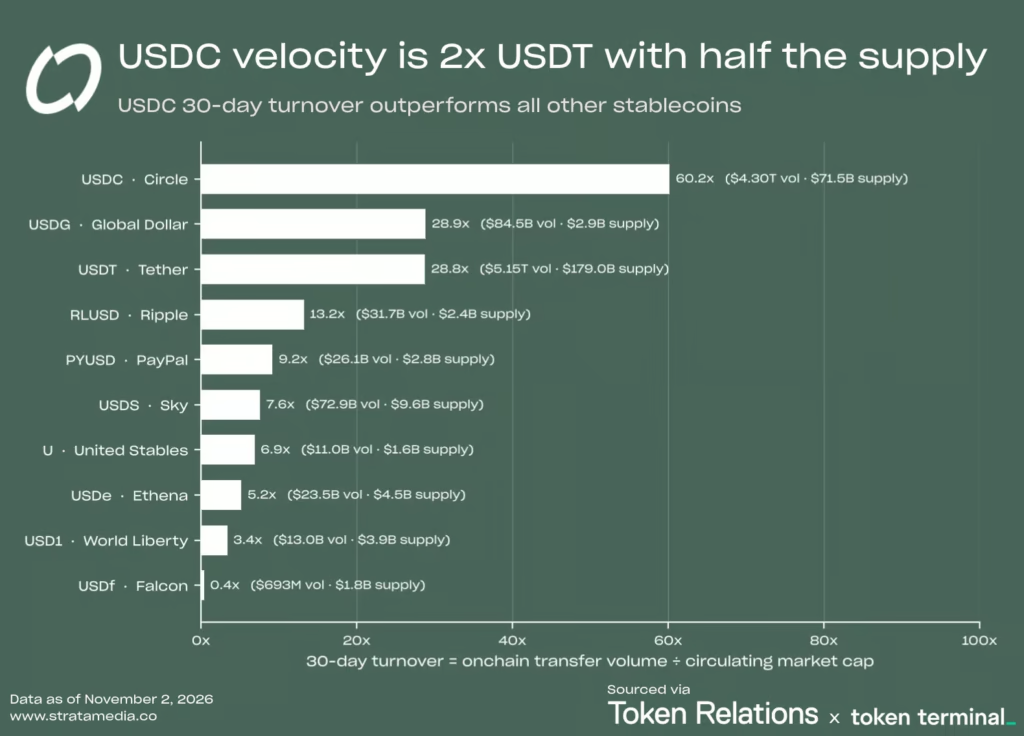
Turnover measures a stablecoin’s velocity: its on-chain transfer volume over 30 days divided by its circulating supply. The higher the number, the more often the coin changes hands.
USDC led the ten largest stablecoins by a wide margin. Its $71.5 billion supply moved $4.30 trillion in 30 days, a turnover of 60.2x. That is more than double USDT’s 28.8x, even though USDC’s supply is about 40% of Tether’s.
| Stablecoin | Issuer | 30-day turnover | Volume | Supply |
| USDC | Circle | 60.2x | $4.30T | $71.5B |
| USDG | Paxos (Global Dollar) | 28.9x | $84.5B | $2.9B |
| USDT | Tether | 28.8x | $5.15T | $179.0B |
| RLUSD | Ripple | 13.2x | $31.7B | $2.4B |
| PYUSD | PayPal | 9.2x | $26.1B | $2.8B |
| USDS | Sky | 7.6x | $72.9B | $9.6B |
| U | United Stables | 6.9x | $11.0B | $1.6B |
| USDe | Ethena | 5.2x | $23.5B | $4.5B |
| USD1 | World Liberty | 3.4x | $13.0B | $3.9B |
| USDf | Falcon | 0.4x | $693M | $1.8B |
Data as of 2 November 2026. Source: Token Relations and Token Terminal.
The coins at the bottom of the list are mostly built to be held for yield, so most of their supply sits in wallets and protocols. The takeaway: the most-used stablecoins are not simply the ones with the biggest market caps.
Top Stablecoin Developments in October
- JPMorgan expanded JPM Coin (JPMD), its dollar deposit token for institutional investors, to the Ethereum mainnet. It is the token’s second public blockchain after Base.
- Ripple won final OCC approval to open Ripple National Trust Bank, which will manage the reserves behind RLUSD and provide digital asset custody. Issuance stays with Ripple’s trust company in New York. Moody’s gave RLUSD investment-grade ratings of A2 (long term) and P-1 (short term).
- HSBC rolled out RedCoin (RCHKD), its first stablecoin. It is backed by the Hong Kong dollar, licensed by the HKMA and available in the PayMe app, whose 3.3 million-plus users can send it to each other or spend it at more than 100,000 merchants.
- Samsung said it would add USDC to Samsung Wallet in the U.S. from late October, letting people send funds to more than 60 countries, where it is converted to local currency.
- Mastercard and BVNK introduced the Global Money Platform, which lets banks and fintechs offer accounts holding both fiat and stablecoins, plus cards tied to stablecoin balances. Mastercard acquired BVNK in August, and this is their first joint product. Mastercard also unveiled Stablecoin Security, which checks stablecoin payments for fraud, scams and sanctions exposure.
- Visa opened stablecoin prefunding on Visa Direct to all users, launched through Inyo Global. Eligible clients can top up cross-border payout balances with USDC.
- Qivalis, the euro stablecoin venture of a group of European banks, obtained an electronic money institution licence from the Dutch central bank, a key step before it can issue its euro token.
- ESMA told MiCA-licensed crypto firms to stop serving EU clients with stablecoins that do not meet MiCA’s rules. Existing positions must be wound down by 8 January 2027.
- RLUSD distribution grew. Coinbase added RLUSD for retail and institutional users on the XRP Ledger, Base and Ethereum. Robinhood made it usable on its own blockchain and on Bitstamp and expects to add it to its app by the end of 2026. BNY began safekeeping RLUSD for custody clients.
- Tether released its third-quarter attestation, showing operating profit of about $1.5 billion and a reserve cushion of roughly $7.95 billion.
- SoFi launched SoFi Earn (SOFIE), a tokenised deposit for retail customers. Balances earn 4.40% APY, carry FDIC insurance and convert 1:1 into the bank’s SoFiUSD stablecoin.
- Canada proposed stablecoin rules requiring non-bank issuers to register with the Bank of Canada, hold 1:1 reserves and redeem at face value within three business days. Issuers could not pay yield. Public comments are open until 23 December.
Frequently Asked Questions
How big is the stablecoin market in October 2026? Total market cap was $284.86 billion, down 3.48% over 30 days. USDT is the largest at $178.14 billion.
When does the GENIUS Act take effect? The law and the OCC’s new implementing rule both take effect on 18 January 2027.
What is stablecoin turnover? It is a stablecoin’s 30-day on-chain transfer volume divided by its circulating supply. It shows how actively a coin is used rather than how much of it exists.
This article is for information only and is not financial advice or a recommendation to make any investment decision. Cryptocurrencies are high risk. Consult a financial professional and do your own research.